









Changed the History of Dance
15 iconic performances from 1832 to 2000 – the story behind each one and fascinating facts that are rarely told.
Dance is an art form that has captivated people throughout the ages. Some ballets, however, have left a mark far deeper than the applause on opening night – they changed technique, costumes, music and even fashion. We have gathered the most iconic of them in chronological order and added the behind-the-scenes stories that make them even more fascinating.
Whether you dance yourself, your child is just discovering ballet, or you simply love going to performances, this list is a great place to start. Most of these titles are still performed on stages around the world today.
La Sylphide
The ballet that opened the Romantic era. Filippo Taglioni created it for his daughter Marie Taglioni, and it premiered on 12 March 1832 at the Paris Opera. It tells the story of James, a young Scotsman who, on his wedding day, is enchanted by a sylph – a forest spirit – and follows her into the woods, abandoning his bride. The ending is tragic: his attempt to hold on to the unattainable destroys the sylph herself.
The version we most often see today, however, is not the Parisian one but the 1836 version by the Danish choreographer August Bournonville, which remains the pride of the Royal Danish Ballet.
- La Sylphide was the first ballet in which dancing en pointe had an artistic meaning rather than being a mere acrobatic trick – Marie Taglioni turned pointe work into a symbol of lightness and otherworldliness.
- It also gave birth to the romantic tutu – the long, calf-length white tulle skirt still known by that name today.
- Bournonville could not afford the original score, so he commissioned new music from the barely 20-year-old Herman Severin Løvenskiold.
- Taglioni’s original choreography is lost. In 1972 Pierre Lacotte reconstructed it for the Paris Opera from surviving engravings and descriptions.
Giselle
Perhaps the best-loved Romantic ballet. Giselle is an innocent peasant girl who falls in love with Albrecht, unaware that he is a nobleman who is already engaged. When the deception is revealed, her heart cannot bear it. In the second act she appears as a Wili – the spirit of a jilted bride, doomed to dance through the night. The Wilis force any man they meet to dance until he dies, but Giselle’s love protects Albrecht until dawn.
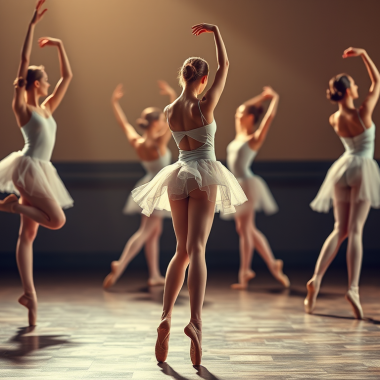
The ballet premiered on 28 June 1841 in Paris, and the role was created especially for the Italian ballerina Carlotta Grisi. The two acts are a complete contrast – a sunny village festival and a ghostly moonlit forest – which is exactly why Giselle tests both the technique and the acting of every ballerina.
- The idea came from the poet Théophile Gautier, who read about the Wilis in Heinrich Heine’s book On Germany and decided these spirits would make a “pretty ballet”. Gautier is said to have been in love with Carlotta Grisi.
- The Wilis come from Slavic folklore – the legend of the spirits of girls who died before their wedding.
- Jules Perrot, who choreographed all of Giselle’s dances, was Grisi’s teacher and partner. After the ballet’s success, her fee doubled.
- The second act is a textbook example of a “ballet blanc” – a corps de ballet in identical white romantic tutus creating a sense of weightlessness.
La Esmeralda
A ballet in three acts and five scenes based on Victor Hugo’s novel. At its heart is the gypsy girl Esmeralda, loved by Captain Phoebus, the bell-ringer Quasimodo and the sinister archdeacon Claude Frollo. It premiered on 9 March 1844 in London at Her Majesty’s Theatre, once again with Carlotta Grisi in the title role.
- At the premiere, the choreographer Jules Perrot himself danced the poet Gringoire, while Phoebus was danced by Arthur Saint-Léon – the future creator of Coppélia.
- Today the full ballet is performed mainly in Russia and Eastern Europe. In the West, usually only excerpts are staged – above all Esmeralda’s pas de deux with the tambourine, a favourite at ballet competitions.
- The famous Diana and Actaeon pas de deux is often linked to La Esmeralda, but it was actually added in 1935 by Agrippina Vaganova for Galina Ulanova and Vakhtang Chabukiani – to music from another ballet.
Don Quixote
A sunny, fiery and highly virtuosic ballet, first staged at the Bolshoi Theatre in Moscow in December 1869. The knight Don Quixote and his faithful Sancho Panza go through adventures, windmills and dreams of the ideal Dulcinea – but the real heroes are Kitri, the innkeeper’s daughter, and the poor barber Basilio, who fight for their love.
- Strange as it may seem, Don Quixote is not the main dancing character at all – he mostly walks and mimes, while Kitri and Basilio take on the hardest parts.
- The version performed around the world today is largely Alexander Gorsky’s from 1900. Petipa was so offended by the changes that he accused Gorsky of shamelessly borrowing his ideas.
- The grand pas de deux from the last act, with its fouettés, is one of the most frequently performed pieces at galas and competitions.
- Famous productions include those by Rudolf Nureyev (Vienna, 1966) and Mikhail Baryshnikov for American Ballet Theatre (1978).
Coppélia
The most famous comic ballet of the 19th century. Franz is engaged to the lively Swanilda but becomes infatuated with the beautiful girl who sits reading all day on the balcony of the eccentric Doctor Coppélius. Except Coppélia is a mechanical doll. Swanilda sneaks into the workshop, puts on the doll’s dress and saves her fiancé from the doctor’s magical experiment. It premiered on 25 May 1870 at the Paris Opera.
- Swanilda was created by 16-year-old Giuseppina Bozzacchi. Just months after her triumph the Franco-Prussian War broke out, and the ballerina died during the siege of Paris – on her 17th birthday.
- At the premiere, Franz was danced by a woman, Eugénie Fiocre, dressed as a man. In Paris this tradition lasted until after the Second World War.
- Coppélia is the most performed ballet in the history of the Paris Opera.
- Its full title is “Coppélia, or the Girl with Enamel Eyes”.
Swan Lake
The ballet of ballets. Prince Siegfried falls in love with Odette, a princess turned into a swan by the sorcerer Rothbart. Only eternal, faithful love can break the spell, but Rothbart sends his daughter Odile – the Black Swan, Odette’s double – to the ball. Tchaikovsky composed the score in 1875–1876, and the premiere at the Bolshoi Theatre took place in March 1877.
- The first production was a failure – the choreography was called dull and Tchaikovsky’s music too complex to dance to.
- Swan Lake as we know it was created only in 1895 at the Mariinsky Theatre – after Tchaikovsky’s death. Lev Ivanov staged the “white” lakeside acts and Petipa the palace acts.
- The famous 32 fouettés of the Black Swan were the signature trick of Italian ballerina Pierina Legnani, who danced Odette/Odile in 1895. Petipa built them into the choreography especially for her.
- The tradition of one ballerina dancing both the White and the Black Swan is one of the greatest challenges in the classical repertoire.
The Sleeping Beauty
The fairy tale of Princess Aurora, cursed by the wicked fairy Carabosse to sleep for a hundred years until Prince Désiré’s kiss awakens her. It premiered on 15 January 1890 at the Mariinsky Theatre in St Petersburg. It was the first collaboration between Tchaikovsky and Petipa and a true hymn to classical ballet – with lavish court costumes, fairies bearing magical gifts and a glittering wedding finale.
- The director of the Imperial Theatres, Ivan Vsevolozhsky, wrote the libretto and designed the costumes himself, inspired by the era of Louis XIV.
- Aurora’s wedding is attended by other characters from Perrault’s fairy tales – Puss in Boots, Little Red Riding Hood, the Bluebird and Princess Florine.
- At the premiere, Enrico Cecchetti danced both the wicked Carabosse and the virtuosic Bluebird.
- The “Rose Adagio”, in which Aurora balances on pointe while four princes turn her one after another, is among the most difficult moments in the ballet.
- It is Tchaikovsky’s longest ballet – almost four hours including intermissions.
The Nutcracker
On Christmas Eve, little Clara (Masha in Russian productions) receives a nutcracker as a gift. During the night the toys come to life, the Nutcracker defeats the Mouse King and takes Clara to the Land of Sweets. It premiered on 18 December 1892 at the Mariinsky Theatre on a double bill with Tchaikovsky’s last opera, Iolanta.
- In Paris, Tchaikovsky discovered a new instrument – the celesta – whose crystal-clear sound became the voice of the Sugar Plum Fairy. He asked his publisher to keep it a secret so that no other composer would use it before him.
- The first production was not a success – critics disliked both the sets and the story. Tchaikovsky did not live to see the ballet’s triumph.
- Today it is the most frequently performed ballet in the world, and for many children it is their first encounter with classical music and ballet.
- The American Christmas tradition began with George Balanchine’s production for New York City Ballet in 1954.
Schéhérazade
A one-act ballet by Sergei Diaghilev’s Ballets Russes, presented at the Paris Opera on 4 June 1910. The story is inspired by One Thousand and One Nights, but it actually tells what happened before the tales: Sultan Shahryar discovers that his favourite, Zobeide, has betrayed him with the Golden Slave. It is this betrayal that explains why the sultan stops trusting women – until the wise Scheherazade begins her stories.
- The Golden Slave was danced by the legendary Vaslav Nijinsky, and Zobeide by Ida Rubinstein.
- Léon Bakst’s bold, vivid colour combinations influenced the fashion and art of an entire era – turbans, harem trousers and oriental motifs found their way into Parisian wardrobes.
- Rimsky-Korsakov had composed the symphonic suite back in 1888 – the ballet was set to already existing music.
The Rite of Spring (Le Sacre du printemps)
Perhaps the most scandalous premiere in the history of the performing arts. On 29 May 1913, at the newly opened Théâtre des Champs-Élysées, the Ballets Russes presented a pagan ritual celebrating the arrival of spring, in which a chosen maiden dances herself to death. The dissonant music, the jerky steps with turned-in feet and the heavy costumes shocked an audience used to elegant ballets such as Swan Lake.
- The work’s subtitle is “Pictures of Pagan Russia in Two Parts”.
- There was shouting, whistling and even fighting in the auditorium, yet the performance continued to the end and was followed by curtain calls. The word “riot” only appeared in accounts years later.
- Nijinsky’s original choreography was performed only eight times and was long thought lost. In the 1980s the Joffrey Ballet reconstructed it.
- More than a hundred choreographers have created their own versions of The Rite of Spring, including Pina Bausch and Martha Graham.
Carmina Burana
Strictly speaking, Carmina Burana is not a classical ballet but a “scenic cantata” for soloists, choir and orchestra. Orff himself, however, conceived it as a work to be danced and staged, which is why it features in the repertoire of many ballet companies. The texts are 24 medieval songs about spring, the tavern and love, and the whole work is framed by the image of the Wheel of Fortune.
- The songs come from a 13th-century manuscript discovered in 1803 at the Bavarian monastery of Benediktbeuern – hence the name, “Songs of Beuern”.
- “O Fortuna” opens and closes the work and is one of the most recognisable melodies in the world, heard in films, adverts and sporting events.
- After the success of Carmina Burana, Orff disowned almost everything he had composed before it.
Romeo and Juliet (Prokofiev)
Shakespeare’s tragedy told through dance: the love between Romeo of the Montagues and Juliet of the Capulets, doomed by the hatred between their families. Prokofiev’s music – with the dramatic “Dance of the Knights” and the tender love duets – is among the most powerful ballet scores of the 20th century.
- Prokofiev finished the score in 1935, but Soviet theatres rejected it as “undanceable”.
- In the original scenario the ballet had a happy ending – Romeo arrives a minute earlier and finds Juliet alive. The idea was dropped after harsh criticism.
- The world premiere took place not in the USSR but in the Czech city of Brno on 30 December 1938. Prokofiev himself was unable to attend.
- The real triumph came with Leonid Lavrovsky’s production at the Kirov Theatre on 11 January 1940, with Galina Ulanova as Juliet.
West Side Story
The musical that moved Romeo and Juliet to 1950s New York. Instead of Montagues and Capulets there are two street gangs, the Jets and the Sharks, and instead of Verona, the narrow streets of the West Side. It opened on Broadway in September 1957, and the 1961 film turned the story into a worldwide phenomenon. Robbins’ choreography blended ballet, jazz and street dance in a way never seen before.
- The project was originally called “East Side Story” and later “Gangway”.
- On Broadway, the musical lost the Tony Award for Best Musical to The Music Man.
- The 1961 film won 10 of its 11 Oscar nominations – a record for a movie musical. Robbins also received an honorary Oscar for his choreography.
- Robbins’ perfectionism delayed filming and pushed the budget up so much that the producers removed him halfway through.
Romeo and Juliet (MacMillan)
British choreographer Kenneth MacMillan’s version is more dramatic and realistic than the Soviet productions. Here Romeo and Juliet are real young people, swept away by passion and crushed by circumstance. The three great pas de deux – the first meeting, the balcony scene and the finale in the tomb – are among the most moving moments in the ballet repertoire.
- It premiered on 9 February 1965 at the Royal Opera House, Covent Garden. It was MacMillan’s first full-length ballet, created in less than five months.
- The ballet was made on Lynn Seymour and Christopher Gable, but for commercial reasons the opening night was danced by the stars Margot Fonteyn (aged 47) and Rudolf Nureyev (aged 28).
- The audience called them back for 43 curtain calls, and the applause lasted almost 40 minutes.
- The Royal Ballet has since performed the production more than 400 times.
Nijinsky
A ballet about the life of one of the greatest dancers of all time – Vaslav Nijinsky, the star of the Ballets Russes, whose genius was gradually consumed by mental illness. It premiered on 2 July 2000 in Hamburg. Neumeier does not tell a biography; instead he shows Nijinsky’s memories, thoughts and visions, with several dancers embodying different sides of his personality.
- The action opens with a real scene: Nijinsky’s last public performance on 19 January 1919 in a ballroom of the Suvretta House hotel in St. Moritz. He called that performance his “Wedding with God”.
- The premiere marked the 50th anniversary of Nijinsky’s death.
- His most famous roles come to life in the ballet – the Golden Slave from Schéhérazade, Petrushka and the Faun.
- Neumeier is one of the world’s foremost Nijinsky experts – his personal collection of objects and documents about the dancer and the Ballets Russes forms the core of his foundation in Hamburg.
All the performances at a glance
| Year | Title | Composer | Why it matters |
|---|---|---|---|
| 1832 | La Sylphide | Schneitzhoeffer / Løvenskiold | The start of Romantic ballet and the romantic tutu |
| 1841 | Giselle | Adolphe Adam | The peak of Romanticism, a “ballet blanc” |
| 1844 | La Esmeralda | Cesare Pugni | Favourite competition variations |
| 1869 | Don Quixote | Ludwig Minkus | Spanish flair and virtuosity |
| 1870 | Coppélia | Léo Delibes | The best-known comic ballet |
| 1877 | Swan Lake | Tchaikovsky | The most popular ballet in the world |
| 1890 | The Sleeping Beauty | Tchaikovsky | The benchmark of classical technique |
| 1892 | The Nutcracker | Tchaikovsky | A Christmas tradition worldwide |
| 1910 | Schéhérazade | Rimsky-Korsakov | Influenced fashion and art |
| 1913 | The Rite of Spring | Stravinsky | The birth of modern dance |
| 1937 | Carmina Burana | Carl Orff | A scenic cantata featuring “O Fortuna” |
| 1938 | Romeo and Juliet | Prokofiev | One of the most powerful ballet scores |
| 1957 | West Side Story | Bernstein | Ballet meets the musical |
| 1965 | Romeo and Juliet (MacMillan) | Prokofiev | 43 curtain calls on opening night |
| 2000 | Nijinsky | Chopin, Schumann and others | A portrait of a genius and his demons |
Different sources give different years for the same ballet. There are several reasons: some works had a world premiere in one country and their “real” premiere in another (Romeo and Juliet), others were reworked years later (Swan Lake, Don Quixote), and 19th-century Russian premieres were recorded in the old Julian calendar, which runs 12 days behind. In this article we give the date of the first performance in front of an audience.
Each of these ballets has its own story, music and choreography – and each was a bold experiment in its time.
How to get to know these ballets
- Start with Tchaikovsky. The Nutcracker is ideal for children and for a first visit to the ballet – especially around Christmas, when almost every opera house stages it.
- Listen to the music beforehand. When the melodies are familiar, it is much easier to follow the story on stage.
- Read the libretto. Ballet has no words, and the plot is told through mime and dance – a few minutes of preparation make the performance much easier to understand.
- Watch recordings of different productions. The same title can look completely different in the hands of different choreographers.
From the stage to the ballet studio
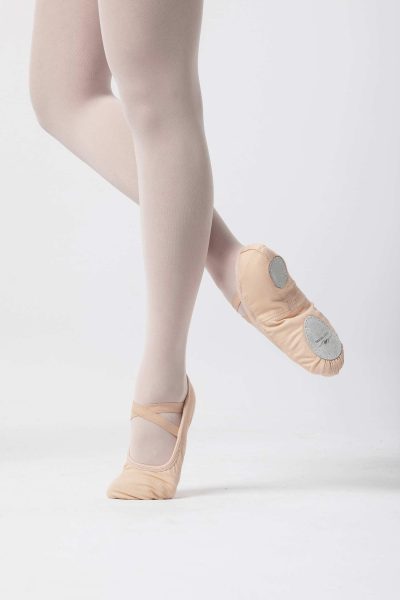
Behind each of these performances lie years of daily work in the studio. If your child dreams of dancing Aurora, Kitri or Odette one day, the journey starts with the right kit – a comfortable ballet leotard, tights, a light ballet skirt and well-fitting ballet shoes. And when the time comes to go on pointe – carefully chosen pointe shoes.
Read more
- How to Choose Pointe Shoes: The Complete Guide
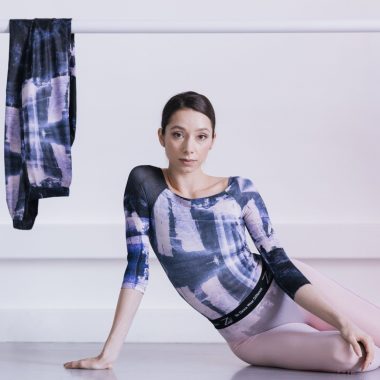
- How to Choose a Ballet Leotard: Everything About Fabric, Cut and Style
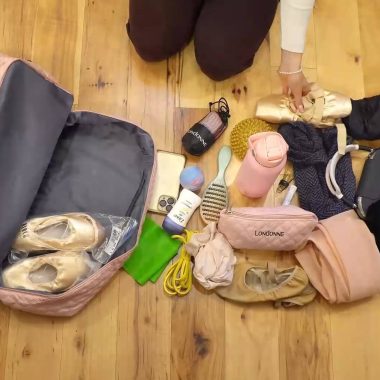
- The Ballet Bag: What to Pack and How to Choose One
- Ballet Tights: The Complete Buying Guide
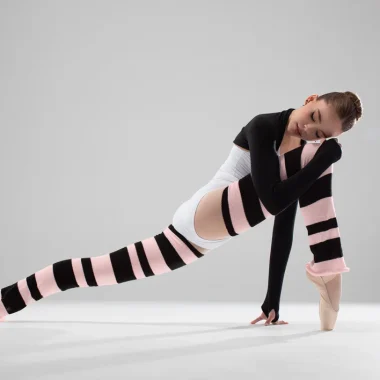
- Ballet Warm-Ups: Why You Need Them and How to Choose
Your stage starts in the studio
Leotards, skirts, pointe shoes and ballet accessories at mjdance.bg – for first steps and for leading roles.
Browse the collection