


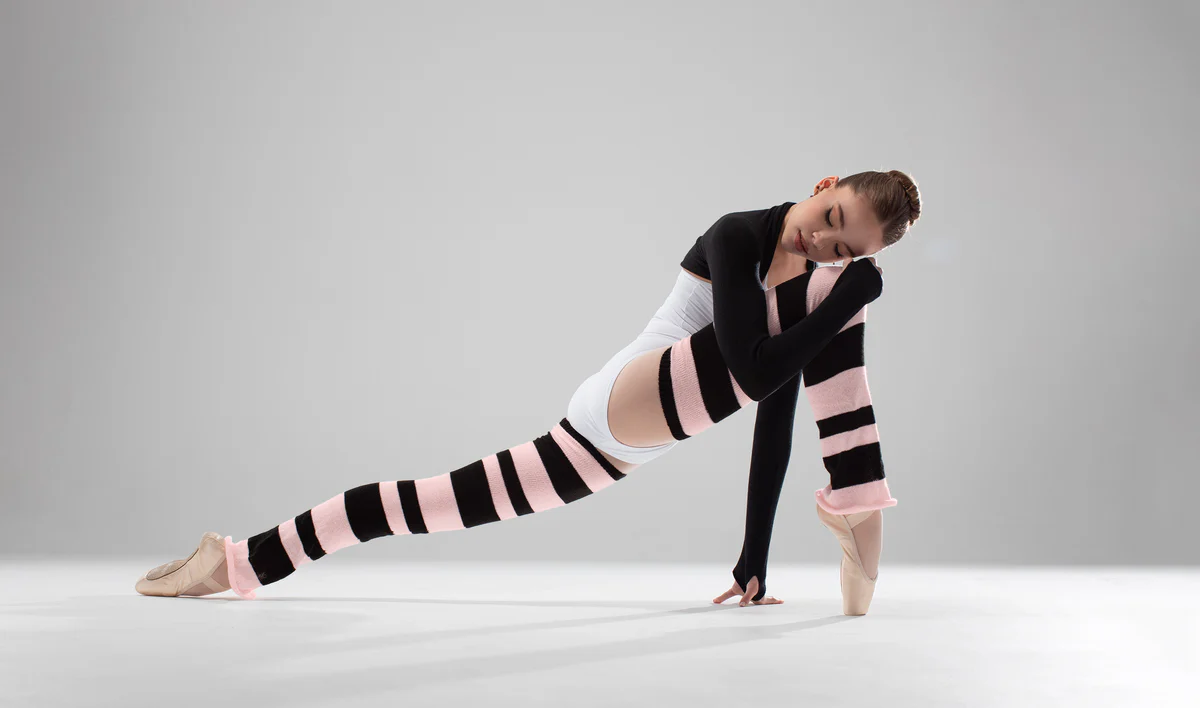
A Dancer’s Most Underrated Protection
Leg warmers, warm-up pants, cardigans, onesies – when, how and why to wear them to prevent injury and dance for longer.
Ballet teachers all agree on one thing: most dance injuries do not happen in the middle of class, but at the very start or after a break – when the muscles are cold. Warm-up clothing is the simple, inexpensive and effective solution that too few ballerinas take seriously.
What happens to your muscles in the cold?
Muscles work best when they are warm – during active work their temperature reaches about 38–39°C. At lower temperatures they become less elastic, coordination suffers, and the risk of torn muscle fibres, tendon injuries and stress fractures rises significantly.
For dancers this is especially critical, because ballet demands an extreme range of motion – grands battements, développés, arabesques with a high leg. Trying these movements with cold muscles is a direct route to injury.
Achilles tendinitis
One of the most common injuries among ballerinas. Cold tendons are far more vulnerable during fast movements.
Muscle strains
Jumps or grands battements without a warm-up can tear muscle fibres, even in experienced dancers.
Stress fractures of the foot
These are caused by repeated loading. When the muscles are not warm and absorb less of the impact, more of the pressure falls on the bones of the foot – especially in young dancers.
Knee pain
The knee joint needs a gradual warm-up. A cold knee in relevé and plié is a recipe for chronic pain.
Fifteen minutes in leg warmers at the start of class can save you three months of rehabilitation.
The right warm-up sequence
Warm-up clothing does not replace a physical warm-up – it complements and improves it. Here is what proper preparation should look like:
Before entering the studio (10–15 min)
Keep your warm-ups on. If it is cold, add a cardigan or a onesie on top. Do not walk straight from a cold corridor into the studio and take everything off.
Warming up at the barre (15–20 min)
Barre work, tendu, dégagé, rond de jambe – the basic exercises at low intensity. Leg warmers and warm-up pants stay on until you feel warmth through your body.
Centre work
Adagio, allegro – by now the body is warm enough. You can take off the extra layers, but keep the leg warmers around your ankles until the studio is warm.
Breaks between exercises
Put your warm-ups back on for any break longer than 5 minutes. This is especially important in cooler studios or in autumn and winter.
After class – cooling down
Put your warm-ups on as soon as you finish. A sudden chill on warm muscles is a common cause of stiffness and soreness the next day.
Types of warm-ups: what is each one for?
Leg warmers
The classic choice of ballerinas all over the world. Leg warmers cover the leg from the ankle to the knee or thigh and keep the Achilles tendon, calves and knee joints warm.
- Leg warmers should be loose enough not to squeeze the blood vessels
- Long, thigh-high leg warmers give better protection for the knee
- Choose a breathable fabric – overly thick leg warmers cause overheating
- Cotton leg warmers are soft and comfortable; acrylic blends hold heat for longer
Warm-up pants
They cover the whole thigh and are especially important for the hip joint. Ballet warm-up pants are slimmer than sports trousers – they do not get in the way of movement, but they keep the key muscle groups warm.
Warm-up cardigans and sweaters
For the upper body – shoulders, back and core. In cooler studios a cardigan is a must, as the back and lower back are particularly vulnerable to cold. Choose a model with an open back or wide neckline so that it does not restrict movement.
Warm-up onesies
They cover the whole body and are especially good for warming up before a rehearsal in a cold room or during the winter months. They are comfortable, but take them off after the main warm-up.
Many professional ballet companies keep their rehearsal studios at around 22–24°C. If your studio is colder, warm-up clothing is essential for the whole class, not just the warm-up.
Choosing a fabric: cotton, acrylic or thermal?
Cotton: Soft, comfortable and breathable. Ideal for warmer studios. Downside: when you sweat it holds moisture and can turn cold – the opposite effect.
Acrylic and blends: Better at holding heat. Cheaper than thermal fabrics. A slightly synthetic feel, but excellent performance in the ballet studio.
Thermal fabrics: Modern technical fabrics designed to retain heat with little moisture. Ideal for cold conditions or for dancers who warm up slowly. A higher price, but more durable and comfortable.
Many students take off their leg warmers after the first few exercises because they feel “warm”. Feeling warm means the warm-up is working – but the muscles have not yet reached the right temperature for serious work. Wait for at least 20 minutes of active movement before taking off your warm-ups.
Intermezzo – the favourite brand for warm-ups
The Intermezzo warm-up collection includes Corcal leg warmers in a wide range of colours (pink, white, black, light blue, lavender), long cotton Maxiband leg warmers with asymmetric stripes, and multicoloured knitted Caytlin leg warmers in three-colour combinations. All models are made from high-quality materials that balance warmth with comfort in movement. In our Warm-ups category you will also find models from Harmony, Mara Dancewear and Zidans.
Warming up young children: special rules
Children’s muscles and tendons are more flexible, but also more vulnerable than those of adults. For children under 10 it is especially important that:
- Leg warmers are soft enough – children’s skin is sensitive to rough synthetic fabrics
- They are not too tight – a child’s foot grows fast and tight leg warmers restrict circulation
- Warm-ups are bright and cheerful – a child will be happier to wear something they like
- Parents check that the child understands when to wear warm-ups – not just at the start, but during breaks too
Buy at least two pairs of leg warmers – one for the studio and one for times when you have to wait before class (reception, corridor, car). Waiting in the cold without leg warmers before class is almost as harmful as exercising without a warm-up.
Read more
- Getting Ready for a Summer Ballet Intensive: A Guide to the Must-Pack Essentials
- The Ballet Bag: What to Pack and How to Choose One
- How to Choose Pointe Shoes: The Complete Guide
- How to Choose a Ballet Leotard: Everything About Fabric, Cut and Style
- Ballet Tights: The Complete Buying Guide
- Back to the Ballet Studio After Summer: How to Get Back in Shape
Protect your body with the right warm-ups
A full collection of leg warmers, warm-up pants and warm-up wear from Intermezzo, Harmony, Mara Dancewear and Zidans with fast delivery. A small investment that makes a big difference.
Shop the collection